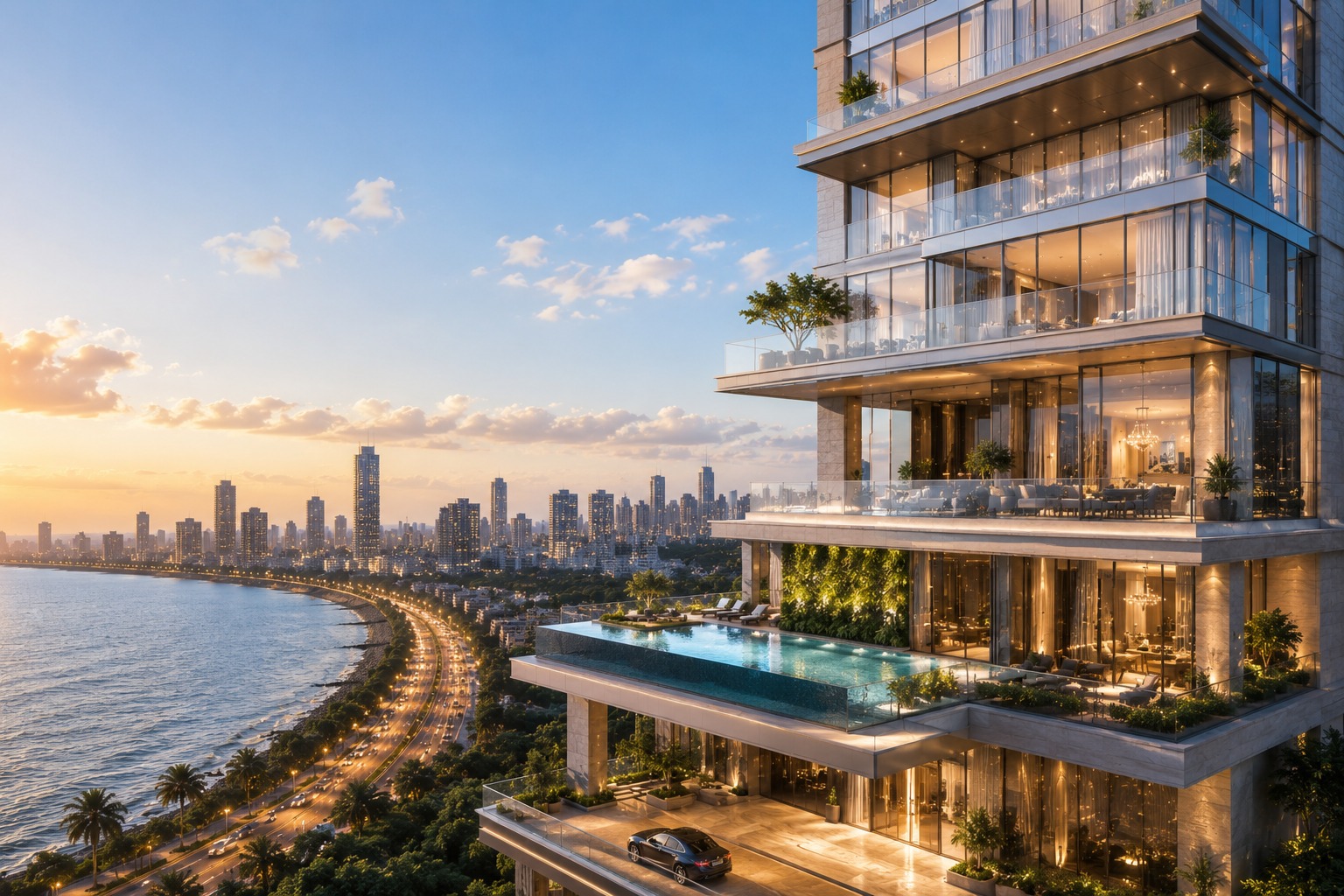



India’s ultra-luxury residential segment continues to behave differently from the broader housing market. Even during periods of economic uncertainty, interest rate movement, or slower transaction activity, prices in prime luxury locations tend to remain stable rather than adjust downward.
Unlike mid-income or premium housing, where price corrections are often used to revive demand, ultra-luxury homes show a clear resistance to repricing. This pricing behaviour, known as price stickiness, is shaped by deeper structural and behavioural forces. For Indian HNIs and UHNIs viewing residential real estate as a long-term wealth asset, understanding this resilience is essential to making informed investment decisions.
What Is Price Stickiness in Residential Real Estate?A
Price stickiness refers to the tendency of property prices to remain steady even when broader market conditions point towards a correction. In the ultra luxury residential segment, this behaviour is not occasional but consistently visible across market cycles.
Rather than responding through price cuts, the market adjusts in more measured ways. Transaction timelines lengthen, deal activity slows, and sellers opt to hold rather than discount. This allows market pressure to be absorbed gradually, keeping benchmark values in India’s ultra luxury residential markets largely stable.
This dynamic naturally leads to a key question: why does price stickiness appear far stronger in ultra luxury housing than in other residential segments?
Why Price Stickiness Dominates Ultra Luxury Residential Markets
Price stickiness can be seen across many asset classes, but it is far more evident in ultra-luxury housing. This is largely due to a combination of supply, seller behaviour, and buyer profile characteristics. To understand this better, it helps to look at the individual forces shaping this behaviour:
Structural Supply Constraints in Prime Luxury Micro Markets
Ultra-luxury residential supply in India is inherently constrained and difficult to replicate.
These constraints ensure that new supply enters the market gradually, preventing oversupply-driven price pressure.
Financial Strength and Long Holding Capacity of Sellers
The seller profile in ultra luxury residential markets is fundamentally different from that in other housing segments.
As a result, price reductions are rarely used as a primary sales strategy, even during slower market phases.
Buyer Profiles With Low Price Sensitivity
Demand in the ultra luxury segment is driven less by affordability and more by asset quality and long-term positioning.
This low price sensitivity reduces the effectiveness of discounts as a demand stimulant, further reinforcing price rigidity.
Transaction Volumes Absorbing Market Cycles Instead of Prices
In ultra-luxury residential markets, volume acts as the primary adjustment mechanism.
This dynamic allows markets to cool without triggering widespread repricing, preserving long-term value benchmarks.
Together, these factors create a market that resists short-term price movement and, in turn, shape how ultra luxury residential assets perform over the long term.
How Price Stickiness Shapes Long-Term Investment Outcomes
For investors, price stickiness is often misunderstood as stagnation. In reality, it reflects a defensive pricing structure that prioritises capital protection. This translates into clear long-term investment advantages:
Price stickiness in ultra luxury residential markets is not an anomaly – it is a feature of how wealth-led real estate behaves. These assets are designed to preserve value first and compound it over time, rather than react to short-term market sentiment. For investors with long holding horizons, this creates a rare combination of downside protection and steady appreciation.
At SQUAREA, we offer curated access to India’s most resilient ultra luxury residential assets, where pricing strength is supported by structural fundamentals rather than market momentum. For tailored investment guidance, reach out at hello@squarea.io or call +91 90 9641 9641.

In recent years, plotted developments have re-entered investment conversations across India. While apartments and integrated townships dominated urban expansion for over a decade, discerning investors are increasingly revisiting land-led formats. The appeal is not merely lifestyle-driven - it is structural. Direct land ownership, lower density, capital appreciation orientation, and flexibility in development timelines are making plotted communities a strategic allocation within high-value portfolios.
For HNIs and UHNIs, plotted development is no longer viewed as fragmented land buying. It is emerging as a regulated, infrastructure-backed, developer-led format that blends land ownership with planned community living.
To understand its investment relevance, let’s first clarify what plotted development represents in today’s regulatory and market framework.
What Is a Plotted Development?A plotted development refers to a large land parcel acquired and legally structured by a developer, subdivided into individual plots with pre-approved layouts and essential infrastructure. Plotted developments typically include:
It shifts the asset from speculative land banking to structured investment-grade positioning. While structurally simple, plotted developments offer a fundamentally different return profile compared to conventional residential apartments.
How Plotted Developments Differ from Traditional Residential AssetsThe divergence lies in ownership structure, appreciation dynamics, and long-term supply characteristics.
| Parameter | Plotted Development | Traditional Apartments / Villas |
|---|---|---|
| Appreciation Driver | Primarily land-led appreciation with a minimal depreciation component | Value is partially tied to the building structure, which depreciates over time |
| Ownership Structure | Direct and clearly defined land title | Undivided share in land with super built-up allocation |
| Construction Flexibility | Owner may build immediately, defer construction, or hold for capital growth | Construction is pre-completed; no flexibility in structural timing |
| Supply Dynamics | Low-density format with finite horizontal expansion | High-density vertical supply can expand through new launches |
| Investment Profile | Capital preservation and long-term land appreciation-oriented | A combination of lifestyle consumption and moderate capital growth |
These structural distinctions position plotted developments closer to long-term capital preservation assets rather than yield-focused residential products. Which explains why HNIs are increasingly allocating strategic attention to plotted communities.
Why HNIs Are Increasingly Considering Plotted DevelopmentsAmong high-net-worth families, plotted developments are being evaluated as strategic land exposure. Here’s why:
In an environment where built inventory cycles fluctuate, land-backed formats offer a different risk-return alignment. However, plotted development requires disciplined evaluation before capital allocation.
Key Factors to Evaluate Before Investing in Plotted DevelopmentsFor investors, due diligence remains paramount. The following elements require careful assessment:
When structured correctly, plotted developments can function as strategic land banking vehicles. While this asset class is nationally relevant, its performance varies significantly by city and growth corridor. This is where Pune presents a compelling case.
Why Pune Is Emerging as a Plotted Development HotspotPune’s expansion trajectory has created ideal conditions for organised, plotted communities.
Plotted developments offer a structured form of direct land ownership within planned, infrastructure-backed communities. For HNIs and UHNIs seeking long-term capital appreciation and wealth preservation, this asset class can serve as a strategic addition within a diversified real estate portfolio.
In growth corridors such as Pune, where infrastructure expansion continues to reshape urban boundaries, plotted communities are moving beyond peripheral alternatives to become well-positioned investment opportunities.
At SQUAREA, we offer curated access to Pune’s most strategically positioned plotted and residential developments aligned with long-term infrastructure growth. For tailored investment guidance, reach out at hello@squarea.io or call +91 90 9641 9641.