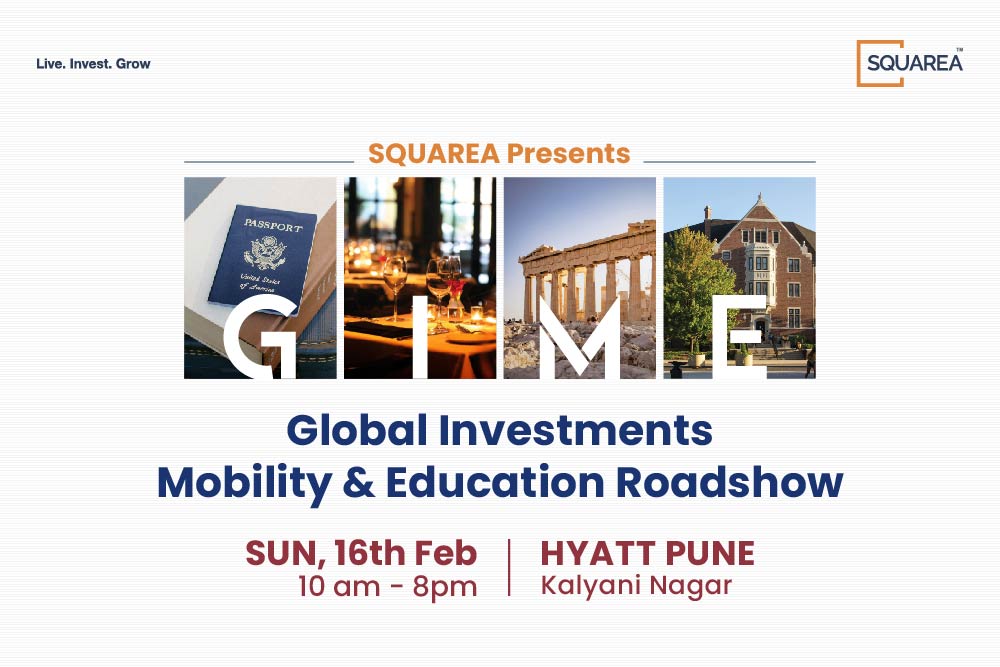
The first-ever Global Investments, Mobility & Education Roadshow 2025 at Hyatt Pune by SQUAREA and Henley Global - Squarea Consulting

    The first-ever Global Investments, Mobility & Education Roadshow 2025 at Hyatt Pune by SQUAREA and Henley Global

    By SQUAREA Knowledge Hub

    Published: February 15, 2025

    Real Estate Press Release - The first-ever Global Investments, Mobility & Education Roadshow at Hyatt Pune by SQUAREA and Henley Global.

    PUNE, MAHARASHTRA, INDIA, February 13, 2025 / EINPresswire.com / — This Sunday, 16th February, SQUAREA presents GIME 2025, Pune’s first-of-its-kind Global Investments, Mobility & Education Roadshow, in partnership with Henley & Partners at Hyatt Pune, Kalyani Nagar. This exclusive event is designed for investors, entrepreneurs, and families looking to secure global residency and citizenship through investment-led routes. As economic landscapes evolve and international mobility becomes increasingly valuable, GIME 2025 will host global experts and offer strategic guidance into International Golden Visa, Permanent Residency, and Citizenship Programs, through cross-border wealth planning, investment, and business expansion routes.

    The event will host programs and country experts from the United States, United Kingdom, Canada, Greece, Portugal, and Latvia. Key programs up for discussion will include the U.S. EB-5 Immigrant Investor Visa, which offers an expedited route to the U.S. Green Card; Portugal’s Golden Residence Permit, a preferred option for those looking to secure Schengen residency through investment; and Canada’s Start-Up Visa Program, designed for tech entrepreneurs aiming to establish and scale businesses in North America. The event will also offer Greece’s Golden Visa, the United Kingdom’s Business Investment and Citizenship Program, and Latvia’s Residency by Investment Program. Alongside, UAE’s Golden Visa Program will also be present.

    In an era where investment migration is increasingly becoming a critical component of growth and lifestyle planning, GIME 2025 aims to bridge the gap between investors and global opportunities.


    Other Stories

    9 December 2025
    Decoding FSI: The Hidden Metric Behind Property Value and Design Efficiency
    In real estate, the value of land is not only defined by location, but also by how efficiently it can be built and scaled. Central to this equation is the Floor Space Index (FSI), a core parameter that governs development potential, density, and design economics. It determines how every square foot is planned, monetised, and experienced. Across key metros like luxury residential investment Pune, Mumbai and Bengaluru, FSI is not just a planning metric but a strategic tool guiding redevelopment, density, and urban growth. For investors, understanding how it works is essential to recognising where design, regulation, and long-term returns converge.

    Understanding FSI and Its Role in Real Estate

    The FSI defines how much built-up area is allowed on a given plot, ensuring optimal land use while maintaining liveability and balance with civic infrastructure. A higher FSI allows more built-up area on the same plot, encouraging vertical growth. Conversely, a lower FSI maintains openness, lower density, and greater privacy, traits often associated with luxury developments. By determining how much potential a plot can unlock, FSI shapes urban expansion, community design, and long-term property value. As FSI governs the blueprint of growth, its evolution through urban policy has become a key indicator of how India’s real estate is maturing.

    Policy Evolution and Regional Variation

    India’s FSI framework has steadily evolved from restrictive control to strategic enablement. Regulations such as Mumbai’s DCPR 2034 have raised permissible FSI in key zones to encourage vertical growth, while Karnataka and Tamil Nadu now allow higher density near metro and transit corridors. Cities like Mumbai offer FSI up to 5 in redevelopment areas, and Chennai and Hyderabad reward projects aligned with sustainability and road infrastructure. This marks a shift from limiting development to optimising it. Developers are increasingly using Transferable Development Rights (TDR) and premium FSI to unlock land potential and enhance project viability. Such regulatory progress has reshaped how value is created, not just in land pricing, but in the design language of high-end real estate.

    FSI and Value Creation in Premium Developments

    For luxury projects, FSI shapes exclusivity, comfort, and spatial hierarchy. A higher FSI enables expansive layouts and premium amenities, but excess density can erode the sense of luxury. The real value lies in proportion and precision, optimising every square foot to enhance both aesthetics and return potential. In well-designed developments, thoughtful use of FSI translates into tangible lifestyle and investment advantages: · Smart spatial planning enhances liveability without compromising scale · Vertical zoning ensures privacy and seamless circulation · Sky decks, private lobbies, and wellness suites elevate experiential appeal · Efficient floor-to-area ratios reduce energy consumption and improve airflow · Architectural balance preserves exclusivity while maximising yield In premium markets, measured FSI use strengthens long-term asset value and investor confidence. Developments that prioritise space efficiency and human experience consistently outperform their peers. After design and density, the next frontier lies in ensuring that growth remains sustainable - where every square foot built also contributes to environmental balance.

    Sustainable Development Through Smarter FSI Utilisation

    High-density growth can only thrive when aligned with sustainability. When managed intelligently, FSI becomes a tool for balance, enabling efficient vertical expansion without burdening the environment. Developers are adopting green codes, renewable energy systems, and low-emission materials to build responsibly. Projects that incorporate solar rooftops, rainwater harvesting, and energy-efficient facades transform density into sustainable design. Many authorities now reward such efforts with FSI incentives for green-certified developments, linking density to environmental performance. For investors, this marks a powerful intersection of profitability and purpose, where sustainability enhances both long-term value and urban well-being. And as sustainability takes centre stage, FSI’s role in driving investment strategy has become even more pronounced.

    FSI As A Strategic Lever For Investment And Urban Growth

    For discerning investors, FSI has become a key indicator of scalability, liquidity, and long-term appreciation potential. Premium FSI zones, often located near metro corridors, business districts, and infrastructure upgrades, consistently deliver stronger rental yields and faster capital growth. Developers acquiring additional FSI demonstrate confidence in a location’s fundamentals and absorption capacity, offering early investors the advantage of entering before full redevelopment cycles mature. Ultimately, FSI is more than a regulatory ratio. It is a strategic lever that links design, policy, and performance, shaping how cities evolve and how investors secure long-term, future-ready value. At SQUAREA, a luxury real estate consultancy Pune, we help investors identify projects that use FSI intelligently, blending innovation, liveability, and architectural excellence. Each asset in our portfolio is curated for its long-term value, sustainable vision, and alignment with evolving market dynamics. For personalised investment guidance, reach us at hello@squarea.io or call +91 90 9641 9641.

    28 November 2025
    From Private Elevators to Sky Decks: The New Status Symbols in Urban Homes
    Luxury living in India’s cities is no longer defined by square footage alone. As skylines evolve, prestige has come to mean far more than location or price. It now embodies privacy, experience, and design. From private elevators that offer exclusivity to sky decks that elevate leisure, high-value residences are increasingly expressions of lifestyle rather than mere ownership. Developers are actively reimagining urban luxury through globally inspired amenities, creating homes that offer distinction as much as comfort. These new symbols of affluence signal a broader change, where luxury is no longer about ownership alone but the emotion and identity that come with it. The Shift From Ownership To Experience For India’s HNIs and UHNIs, luxury has transitioned from material to experiential. Prime location and architectural scale remain important, but what defines true luxury today is discretion, customisation, and access. · Personalisation: From branded interiors to curated art and furnishings, customisation is now central to luxury identity. · Privacy: Limited residences per floor, private foyers, and dedicated entrances offer exclusivity and discretion. · Access: Concierge, wellness, and hospitality services integrate convenience with prestige. This evolution has set the stage for amenities that prioritise comfort without compromise, starting with the most intimate of luxuries - privacy.

    Private Elevators And Bespoke Entrances: Privacy Becomes Prestige

    Once reserved for penthouses, private elevators and individual lobbies have become key features in luxury towers. They provide not just convenience but exclusivity. Developers in cities like Mumbai, Gurugram, and Pune are integrating dedicated lift systems and personal vestibules as standard in premium projects. For buyers, this feature represents both status and security, an unspoken symbol of social stature. But as privacy becomes the norm, the next frontier of distinction is spatial, where panoramic views and elevated leisure define the experience of modern living.

    Sky Decks And Rooftop Lounges: A Vertical Leisure

    In dense urban skylines, open space has become the ultimate rarity. Sky decks, rooftop pools, and skyline lounges are redefining what leisure means in a vertical world. From infinity pools overlooking Worli’s seafront to sky lounges in Pune’s Financial District, developers are transforming rooftops into social sanctuaries. These spaces offer more than views. They provide a sense of calm, exclusivity, and elevation that no ground-level amenity can replicate. Such vertical leisure concepts reflect a global shift where height equals distinction, and serenity comes from the skyline itself. As leisure moves upward, wellness is becoming the next cornerstone of aspirational living.

    Wellness And Biophilic Living: The New Core Of Comfort

    Modern affluent buyers are prioritising holistic wellness within their homes. From oxygen-enriched fitness studios to aromatherapy zones, residences are being crafted around physical and mental well-being. Developers are increasingly responding to this demand and embracing biophilic design, integrating natural light, ventilation, and indoor greenery to promote calm and productivity. Fitness studios, meditation spaces, and spa suites further embed self-care into daily life. Beyond aesthetics, these choices address the growing awareness among HNIs of sustainability and lifestyle balance in urban environments. The focus on wellness naturally aligns with sustainability, where luxury meets responsibility.

    Smart And Sustainable Design: Technology As The Silent Status Symbol

    In a market increasingly shaped by innovation, technology has become the new measure of sophistication. Automated lighting, voice-controlled climate systems, and intelligent security solutions now define high-end living. Sustainability, once considered niche, is now integral. IGBC and LEED-certified projects are setting benchmarks in energy efficiency, while eco-conscious materials and smart water systems ensure long-term value preservation. For HNIs, these features represent a commitment to both comfort and conscience, an evolved form of luxury where design meets responsibility. This alignment of technology, sustainability, and wellness together is shaping the next chapter of Indian luxury housing.

    The Next Phase: Experience, Sustainability, And Identity

    India’s luxury segment continues to mature, led by developers who blend architectural excellence with global sensibilities. The modern homebuyer no longer seeks opulence alone. They seek meaning, identity, and a reflection of self. Luxury is becoming quieter, more intentional, and infinitely more personal. The homes of tomorrow will be defined not just by grandeur but by their ability to offer peace, privacy, and permanence in a restless urban landscape. At SQUAREA, we curate India’s most refined developments, from residences with sky decks and private lift access to wellness-led, sustainable homes that reflect individuality and balance. Each property is chosen for its design excellence, long-term value, and alignment with the evolving definition of modern luxury. For personalised investment guidance, reach us at hello@squareaor call +91 90 9641 9641.
    15 November 2025
    How Dubai’s Real Estate Model Offers Insights for India’s Next Growth Phase
    Dubai’s transformation into a global real estate powerhouse provides valuable insights for rapidly evolving markets, such as India. In just two decades, Dubai has built a property ecosystem grounded in transparency, accessibility, and investor trust, attributes that have turned it into a magnet for global capital. India’s property sector is now entering a similar phase of structural maturity, driven by regulatory reforms, expanding institutional participation, and rapid urbanisation. The conversation, therefore, is not about comparison but perspective – identifying elements of Dubai’s success that can complement India’s growth and strengthen its path towards global competitiveness.

    Insights from Dubai: Strengthening India’s Real Estate Future

    Several pillars define Dubai’s success, right from investor accessibility and transparency to yield efficiency and urban planning, each offering lessons that can inform India’s next phase of real estate growth.

    Accessibility and Investor Confidence

    Dubai’s property market is built on openness. Foreign nationals can own property outright in designated freehold zones, enjoying full rights of sale, lease, and transfer without requiring residency or citizenship. This inclusivity unlocked global participation and set a precedent for investor-friendly policy (Sobha Realty). India has made significant progress through FDI liberalisation and the implementation of RERA, which has strengthened buyer protection and market discipline. The next step lies in simplifying ownership structures and approval processes to further attract cross-border and NRI capital. Accessibility initiates investor participation, and trust in governance sustains it. Once ownership structures encourage participation, the next step is ensuring transparency that underpins long-term confidence.

    Transparency as a Growth Pillar

    Dubai ranks third globally in JLL’s 2024 Global Real Estate Transparency Index, reflecting a decade of reform in land registration, digitalisation, and data accessibility. This consistency of governance allows investors to evaluate risk and reward with clarity, a cornerstone of long-term participation (JLL). India has made meaningful strides through RERA and the ongoing digitisation of land and property records. The next phase lies in creating a more unified national framework that ensures these standards are consistently applied across states. As Dubai’s model shows, transparency is not just about access to information; it is about predictability and confidence that attract long-term capital. Transparency sets the stage for performance, and that’s where yield efficiency becomes the next critical differentiator.

    Yield Performance and Market Efficiency

    Dubai’s rental yields, averaging between 7% and 11%, are among the world’s highest. Indian metros such as Mumbai and Bengaluru, by contrast, average 2% to 4%. With property prices often comparable, a 2,500 sq. ft. apartment in Dubai may cost AED 1.5-3.5 million, similar to Mumbai or Gurugram’s prime districts. Dubai’s advantage lies in process efficiency, consistent occupancy, and investor-centric regulations. (Financial Express) For India, the opportunity lies in strengthening the rental housing ecosystem and scaling institutional platforms that make income-generating real estate more accessible. A stable rental framework not only enhances yield potential but also attracts long-term domestic and international capital. Financial clarity is essential, but so is policy simplicity, a domain where Dubai’s fiscal structure offers useful direction.

    Simplified Taxation and Policy Clarity

    Fiscal simplicity remains one of Dubai’s strongest differentiators. There is no tax on rental income or capital gains, and only a 4% transfer fee applies (Shuraa Tax). This transparency allows investors to plan and price with confidence, encouraging long-term participation. India’s tax environment, though improving, remains complex. Streamlining capital gains treatment, aligning stamp duties, and ensuring consistency across states could help build similar confidence. Predictability in taxation not only protects returns but also signals maturity in governance, a crucial element for global investors. As regulation and taxation evolve, the next frontier lies in city planning, where infrastructure and design turn policy into value.

    Integrated Urban Planning and Long-Term Value

    Dubai’s urban growth is guided by a unified master vision. Developments such as Business Bay, Downtown Dubai, and Dubai Marina integrate residential, commercial, and leisure spaces supported by transport and infrastructure. The result is a city designed for both liveability and investment continuity. India is already moving towards this model through integrated township policies, metro corridor development, and the Smart Cities Mission. Scaling such initiatives with consistent execution can drive both capital appreciation and social value. Infrastructure, as Dubai proves, is not a secondary input, it is the foundation on which long-term real estate value is built.

    A Shared Vision For Real Estate Excellence

    Dubai’s experience demonstrates how disciplined governance and investor-first policies can transform an entire market. India’s story, meanwhile, is one of scale, innovation, and demographic strength. For India, the opportunity lies in adaptation, not imitation - refining its frameworks while embracing global best practices in transparency, planning, and fiscal clarity. At SQUAREA, our curated portfolio spans high-value properties across India and Dubai, from premium developments in India’s leading cities to landmark projects in Dubai’s most sought-after districts. Each asset is evaluated for transparency, yield potential, and long-term appreciation, enabling you to build a portfolio that strikes a balance between stability and opportunity. To explore exclusive investment options tailored to your goals, reach us at hello@squarea.io or call +91 90 9641 9641.